

Academy > Market Structure
Understanding Max Pain
What Is Max Pain?
Max Pain is a mathematical calculation that identifies the strike price where the combined theoretical payout to option holders would be lowest at expiration based on current Open Interest. It provides additional market context but should not be interpreted as a prediction of where a stock will close.
Introduction
As traders begin exploring option market structure, they often encounter the term Max Pain. Some traders consider it an important market observation. Others place very little emphasis on it. Like many option market measurements, opinions vary.
Max Pain is not a prediction of where a stock will close. It is a mathematical calculation based on the distribution of open option contracts across the displayed expiration. Rather than forecasting future prices, Max Pain identifies the strike where the combined theoretical payout to option holders would be at its lowest if the stock expired at that price. Whether the market ultimately moves toward that level is a separate question.
Understanding what Max Pain measures and what it does not measure is the key to using it appropriately.
Why Traders Watch Max Pain
Every option contract represents a potential obligation at expiration. Calls and puts each create different payout scenarios depending on where the stock closes.
Max Pain examines every available strike within an expiration and calculates the theoretical payout that would occur if expiration happened at each one. After comparing every strike, the calculation identifies the price where the total payout would be lowest. That price becomes the Max Pain value.
Some traders monitor this level because they believe it may provide additional insight into the structure of the option market as expiration approaches. Others simply view it as another interesting mathematical observation.
Regardless of how it is interpreted, Max Pain is best understood as market context rather than market prediction.
How Max Pain Is Calculated
Although the mathematics behind Max Pain can become extensive, the concept is straightforward.
For each strike within the selected expiration:
- Calculate the theoretical payout to all open call contracts.
- Calculate the theoretical payout to all open put contracts.
- Combine those values.
- Repeat the process for every available strike.
- Identify the strike with the lowest combined payout.
That strike represents the calculated Max Pain level. The calculation depends entirely on the displayed Open Interest within the selected expiration. As Open Interest changes, the calculated Max Pain level may also change.
A Simple Example
Imagine an expiration containing five strike prices.
After evaluating every strike, the combined theoretical payouts appear as follows:
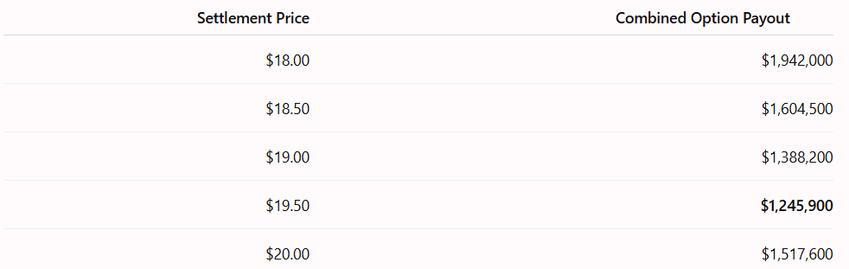
The $19.50 strike produces the lowest theoretical payout. That becomes the calculated Max Pain level.
Does this mean the stock will expire at $19.50? No. It simply means that, based on the displayed Open Interest, $19.50 represents the lowest combined payout among the available settlement prices.
Max Pain Is Not a Prediction
Perhaps the biggest misconception surrounding Max Pain is that stocks naturally move toward the Max Pain strike. Reality is far more complex.
Stock prices are influenced by:
- Company news
- Earnings
- Economic events
- Institutional trading
- Market sentiment
- Supply and demand
- Overall market conditions
Max Pain does not override these factors. Some stocks finish near the calculated level. Many do not. For this reason, Max Pain should never be interpreted as a forecast.
It represents one mathematical view of the current option market structure. Nothing more. Nothing less.
How Traders May Use Max Pain
Different traders incorporate Max Pain differently. Some monitor it only during expiration week. Some compare it to nearby Put Walls and Call Walls. Others ignore it completely.
There is no universally accepted approach. Like every objective calculation, Max Pain becomes more meaningful when considered alongside other information, including:
- Open Interest
- Put Walls
- Call Walls
- Current stock price
- Earnings
- Market Structure
- Existing position
- Personal trading objectives
Viewed in isolation, Max Pain tells only part of the story. Viewed alongside other objective measurements, it becomes another piece of market context.
How OptionLogic Uses Max Pain
OptionLogic calculates Max Pain using the displayed option chain for the selected expiration. Rather than relying on external estimates, the software evaluates the displayed Open Interest and calculates the theoretical combined payout at every available strike. The strike producing the lowest payout becomes the displayed Max Pain value.
OptionLogic presents this information as another objective market measurement. It is not highlighted as a prediction or recommendation. Instead, it joins Put Walls, Call Walls, ROI, Annualized ROI, and other calculations to help traders better understand the structure of the option market.
The software performs the mathematics. The trader determines whether the information is relevant.
Common Misconceptions
Misconception 1: Max Pain Predicts Where the Stock Will Expire
No.
It identifies the settlement price producing the lowest theoretical payout based on the displayed Open Interest.
It is not a forecast.
Misconception 2: Stocks Always Move Toward Max Pain
Some stocks finish near the calculated level.
Many finish elsewhere.
Market prices are influenced by many factors beyond option positioning.
Misconception 3: Max Pain Should Be Used Alone
Like every market measurement, Max Pain should be evaluated together with other objective information.
No single calculation explains the entire market.
Misconception 4: Max Pain Never Changes
Open Interest changes throughout an option cycle.
As positions are opened and closed, the calculated Max Pain level may also change.
Key Takeaways
Remember these principles:
- Max Pain is a mathematical calculation.
- It identifies the strike with the lowest combined theoretical payout.
- It is based on Open Interest.
- It is not a price prediction.
- It provides additional market context when evaluated alongside other measurements.
How OptionLogic Helps
OptionLogic automatically calculates Max Pain using the displayed option chain for the selected expiration. Rather than requiring traders to manually evaluate payouts across every strike, the software performs the calculations and presents the result alongside other objective market measurements.
Max Pain becomes another piece of information helping traders understand the structure of the option market.
The software provides the calculation. The trader decides how much importance to place on it.
Frequently Asked Questions
What is Max Pain in options trading?
Max Pain is the strike price where the combined theoretical payout to option holders would be lowest at expiration based on current Open Interest.
Does Max Pain predict where a stock will close?
No. Max Pain is a mathematical calculation based on Open Interest. It should be viewed as market context rather than a price prediction.
How is Max Pain calculated?
The calculation compares the theoretical payout of all open call and put contracts at every available strike price. The strike with the lowest combined payout becomes the Max Pain level.
Does Max Pain change?
Yes. As Open Interest changes throughout an option cycle, the calculated Max Pain level may also change.
Should Max Pain be used by itself?
No. Like every market measurement, Max Pain is most useful when evaluated alongside Open Interest, Put Walls, Call Walls, price action, and other objective information.