

Academy > Market Structure
What is a Call Wall?
Academy-> What is a Call Wall
What Is a Call Wall?
A Call Wall is the strike price with the highest Call Open Interest for a selected option expiration. It identifies where the greatest concentration of open call contracts currently exists. Many traders use Call Walls as market context when evaluating option opportunities, but they should not be interpreted as guaranteed resistance or a prediction of future price movement.
Introduction
Every option chain contains strike prices where market participation varies significantly. Some strikes have relatively few open contracts. Others become areas where thousands of option positions remain outstanding.
A Call Wall identifies the strike price containing the largest concentration of Call Open Interest for a particular expiration. Like every market structure measurement, a Call Wall does not predict future price movement. Instead, it highlights where option market participation is currently concentrated on the call side of the option chain.
For many traders, this becomes another piece of objective market information that may help place an opportunity into context. Understanding what a Call Wall represents and what it does not, is the key to interpreting it correctly.
Why Traders Watch Call Walls
When reviewing an option chain, every strike initially appears equally important. However, Open Interest often reveals that market participation is not evenly distributed. Some strikes attract relatively few contracts. Others become areas where significant numbers of option positions remain open.
The strike with the largest concentration of Call Open Interest becomes the Call Wall. Traders often monitor these areas because they may represent locations where substantial option activity has accumulated.
That activity may involve:
- Covered call sellers
- Call buyers
- Institutional hedging
- Multi-leg option strategies
- Other market participants with very different objectives
Open Interest does not explain why those positions exist. It simply identifies where they are concentrated.
A Call Wall Is Not Resistance
One of the most common misunderstandings is believing a Call Wall guarantees resistance. It does not. Stocks frequently move through Call Walls. Sometimes price pauses nearby. Sometimes it reverses. Sometimes it continues moving higher without hesitation. A Call Wall should therefore be viewed as: An area of market participation not a prediction that price will stop. Like every market measurement, it represents one piece of information rather than a complete trading decision.
A Simple Example
Imagine a stock currently trading at $31.40.
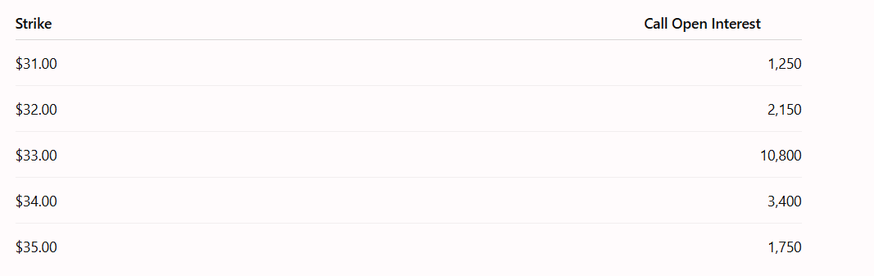
The $33 strike contains the largest Call Open Interest. This becomes the displayed Call Wall. Does this mean the stock cannot trade above $33? No.
Does it guarantee sellers will appear? No.
It simply identifies where the largest concentration of Call Open Interest currently exists for the selected expiration.
That concentration becomes another piece of objective market context available to the trader.
How Traders May Use Call Walls
Different traders incorporate Call Walls into their analysis differently. Some simply use them as another market reference point. Others compare potential covered call strikes to nearby Call Walls while evaluating opportunities.
Some ignore them completely. There is no universally correct approach.
Like every objective calculation, Call Walls become most valuable when evaluated alongside other information, including:
- Current stock price
- ROI
- Annualized ROI
- Distance to strike
- Earnings
- Bid/Ask spread
- Existing position
- Personal trading objectives
Viewed this way, the Call Wall becomes another piece of the overall market picture rather than a standalone indicator.
How OptionLogic Uses Call Walls
OptionLogic automatically scans the displayed option chain and identifies the strike containing the highest Call Open Interest for the selected expiration.
That strike is labelled: CW - Call Wall
The corresponding row is highlighted, allowing traders to immediately identify where Call Open Interest is most heavily concentrated.
Rather than requiring users to manually compare Open Interest across dozens of strikes, OptionLogic organizes that information visually. The software does not suggest the Call Wall represents guaranteed resistance. It simply identifies where option market participation is concentrated so traders can evaluate that information alongside every other objective calculation.
Common Misconceptions
Misconception 1: The Call Wall Predicts Resistance
No.
A Call Wall identifies concentrated Call Open Interest.
Price may stop, pause, reverse, or move directly through that strike.
Misconception 2: The Largest Call Wall Is Always the Best Strike
Large Open Interest does not automatically make a strike a better covered call opportunity.
The existing position, premium, ROI, expiration, and personal objectives remain equally important.
Misconception 3: Every Trader Interprets Call Walls the Same Way
Some traders monitor Call Walls closely.
Others consider them only one small part of their overall analysis.
Neither approach is inherently correct.
Misconception 4: Call Walls Should Be Used Alone
Like every market measurement, Call Walls should be evaluated together with other objective information.
No single indicator should determine a trading decision.
Key Takeaways
Remember these principles:
- A Call Wall identifies the strike with the highest displayed Call Open Interest.
- It represents market participation not market prediction.
- Call Walls do not guarantee resistance.
- They provide context alongside other market information.
- Objective decisions come from evaluating multiple measurements together.
How OptionLogic Helps
OptionLogic automatically identifies and highlights the Call Wall for the displayed expiration, eliminating the need to manually compare Call Open Interest throughout the option chain. Rather than presenting the Call Wall as a trading signal, the software treats it as another objective measurement that helps organize market information. It becomes one additional piece of context available to the trader when evaluating opportunities.
The software identifies the concentration. The trader determines its significance.
Frequently Asked Questions
What is a Call Wall?
A Call Wall is the strike price containing the highest concentration of Call Open Interest for a selected expiration date.
Why do traders watch Call Walls?
Many traders monitor Call Walls because they identify areas where option positions are heavily concentrated. This information can provide additional market context when evaluating covered call opportunities and overall market structure.
Does a Call Wall guarantee resistance?
No. A Call Wall does not guarantee that a stock will stop rising or reverse direction. It simply identifies where the largest concentration of call option positions currently exists.
How is a Call Wall determined?
A Call Wall is identified by comparing the Open Interest of all call options for the selected expiration. The strike with the highest Open Interest becomes the Call Wall.
Can a Call Wall change?
Yes. As traders open, close, exercise, or allow contracts to expire, Open Interest changes. As a result, the Call Wall may also move from one strike to another over time.
Does OptionLogic use Call Walls to predict prices?
No. OptionLogic displays Call Walls as an objective measure of market structure. They are intended to provide context alongside Put Walls, Open Interest, ROI, and other objective calculations not to predict future price movement.