

Academy > Market Structure
Open Interest Explained
Academy-> Open Interest Explained
What Is Open Interest?
Open Interest is the total number of option contracts that remain open for a specific strike price and expiration date. Unlike trading volume, which measures contracts traded during a session, Open Interest measures contracts that are still active. It helps traders identify where option positions are concentrated but does not predict future price movement.
Introduction
An option chain can contain hundreds of contracts spread across different strike prices and expiration dates. Each contract displays its own bid, ask, volume, implied volatility, and other measurements. The challenge is not finding data. The challenge is understanding where market participants already have positions.
Open Interest provides part of that context. Open Interest represents the number of option contracts in a particular option series that remain open and have not yet been closed, exercised, or allowed to expire. Unlike daily volume, which measures trading activity during a session, Open Interest reflects outstanding positions carried forward in the market.
For traders evaluating cash-secured puts, covered calls, or other option opportunities, Open Interest can help reveal where participation is concentrated across the option chain.
It does not predict price movement.
It does not identify whether traders are bullish or bearish.
It simply shows where open contracts currently exist.
Understanding that distinction is the foundation for interpreting Put Walls, Call Walls, and other forms of option market structure.
Open Interest and Volume Are Not the Same
Open Interest and volume are often displayed beside each other, but they answer different questions. Volume asks: How many contracts traded during the current session? Open Interest asks: How many contracts remain open in this option series?
Imagine that a particular call option has:
- Volume of 800 contracts
- Open Interest of 4,500 contracts
The volume indicates that 800 contracts changed hands during the session. The Open Interest indicates that 4,500 contracts remained open when the figure was calculated. A contract included in today’s volume does not necessarily increase Open Interest. The transaction may open a new position, close an existing position, or transfer an existing position between market participants.
For that reason, volume measures activity while Open Interest measures outstanding positions. Both measurements are valuable, but they describe different parts of the market.
Open Interest Does Not Reveal Direction
One of the most common mistakes traders make is assuming that high call Open Interest is automatically bullish or that high put Open Interest is automatically bearish. Open Interest alone cannot reveal market direction. Every open option contract has both a buyer and a seller.
A call buyer may have a bullish outlook, while the call seller may have a neutral, bearish, or income-focused objective.
A put buyer may be bearish, hedging an existing position, or protecting portfolio value.
The put seller may be willing to purchase shares or may be participating in a multi-leg strategy.
The same Open Interest number includes both sides of those relationships.
The Options Industry Council specifically notes that Open Interest does not, by itself, indicate a bullish or bearish outlook.
This means Open Interest should be interpreted as evidence of participation, not evidence of intent.
Why Traders Watch Open Interest
Although Open Interest does not predict direction, it can still provide valuable context. When a large number of contracts are concentrated at a particular strike, that strike may deserve additional attention.
It may represent:
- A widely traded strike
- A commonly used hedge
- A popular income position
- Part of larger multi-leg strategies
- An area where significant option exposure exists
The reason behind the concentration cannot be determined from Open Interest alone. However, knowing where positions are concentrated helps traders understand the structure of the displayed option market. Rather than viewing every strike as equal, traders can identify where participation is greatest and consider that information alongside price, liquidity, ROI, earnings, and the position being managed.
Open Interest adds context. It does not provide a conclusion.
A Simple Example
Imagine a put option chain with the following Open Interest:
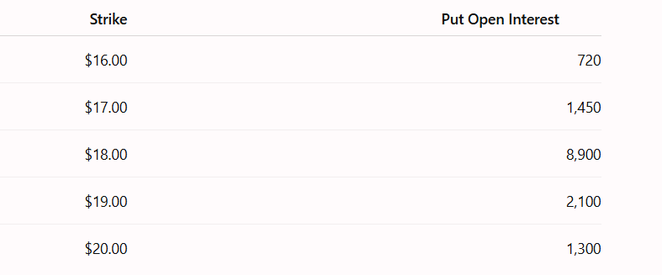
The $18 strike contains substantially more Put Open Interest than the surrounding strikes. That does not prove the stock will remain above $18. It does not prove the strike represents support. It does tell the trader that the largest concentration of open put contracts within the displayed chain exists at $18.
That concentration may be relevant when comparing nearby cash-secured put opportunities.
For example, a trader might examine:
- Whether a proposed strike sits above or below the concentration
- How far the strike is from the current stock price
- Whether sufficient liquidity exists
- How the available ROI compares
- Whether an earnings announcement is approaching
- How the strike fits the trader’s own willingness to accept assignment
Open Interest does not answer those questions. It helps identify where another question may be worth asking.
High Open Interest Does Not Guarantee Liquidity
Open Interest is often associated with liquidity, but the relationship is not absolute. A contract with substantial Open Interest may attract more participation than a contract with almost none. However, Open Interest alone does not guarantee that a trader will receive a favourable execution price.
Liquidity should also be evaluated through factors such as:
- Bid and ask prices
- Bid/ask spread
- Current volume
- Available market depth
- Trading activity in the underlying stock
A contract may show meaningful Open Interest while still displaying a wide bid/ask spread. Likewise, a newly listed contract may have low Open Interest but active trading and a competitive spread. Open Interest contributes another piece of information.
It should not replace direct evaluation of the market available at the time of the trade.
Open Interest Changes Over Time
Open Interest is not permanent. Positions are opened. Positions are closed. Contracts are exercised. Expirations remove entire option series from the market.
As those events occur, the concentration of Open Interest across strikes can change. A strike that attracts the most attention during one expiration cycle may not remain dominant in the next. This is why market structure should be viewed as current context rather than a fixed rule. The option market evolves as traders adjust positions and new information becomes available.
Open Interest describes that structure at a particular point in time.
How Open Interest Leads to Put Walls and Call Walls
Open Interest becomes especially useful when contracts are compared across the same displayed expiration.
If one put strike contains the largest concentration of Put Open Interest, traders may refer to that strike as a Put Wall.
If one call strike contains the largest concentration of Call Open Interest, it may be described as a Call Wall.
These labels help traders identify where option positions are concentrated without manually scanning every Open Interest value.
However, Put Walls and Call Walls inherit the same limitations as Open Interest itself. They describe concentration.
They do not guarantee support, resistance, or future price movement.
Understanding Open Interest first prevents traders from treating these levels as predictions.
How OptionLogic Uses Open Interest
OptionLogic displays Open Interest as part of the objective information available for each option contract.
It also compares Open Interest across the displayed chain to identify the largest Put and Call concentrations for the selected expiration.
These levels are displayed as:
- PW — Put Wall
- CW — Call Wall
The corresponding rows are visually highlighted, allowing traders to identify concentrated Open Interest without manually comparing every contract.
OptionLogic does not interpret these levels as guaranteed support or resistance. It identifies where the concentration exists.
The trader can then evaluate that information alongside:
- Strike price
- Current stock price
- ROI
- Annualized ROI
- Distance from the stock price
- Bid/ask spread
- Earnings awareness
- Current Position P/L
- Personal trading objectives
The software identifies the structure. The trader determines its relevance.
Common Misconceptions About Open Interest
Misconception 1: High Call Open Interest Is Bullish
Every call contract has both a buyer and a seller. The Open Interest number does not reveal which side initiated the position or the strategy behind it. High Call Open Interest indicates concentration, not direction.
Misconception 2: High Put Open Interest Is Bearish
Put contracts may be purchased for speculation, used as protection, sold for income, or included within larger strategies.
The Open Interest figure does not distinguish between those purposes.
High Put Open Interest does not automatically represent bearish sentiment.
Misconception 3: Open Interest Predicts Support or Resistance
A concentrated strike may become an area traders watch. However, the stock can move through that level.
Open Interest provides market context, not a price barrier.
Misconception 4: The Strike With the Highest Open Interest Is the Best Trade Open Interest says nothing about whether the available premium, return, assignment outcome, or capital commitment fits the trader’s objectives.
It is one measurement among many.
Misconception 5: Open Interest and Volume Are Interchangeable
Volume measures trading activity during a session. Open Interest measures contracts that remain open.
They should not be interpreted as the same measurement.
Key Takeaways
Open Interest helps reveal where option positions are concentrated within the market.
Remember these principles:
- Open Interest represents contracts that remain open.
- Volume represents contracts traded during a session.
- Open Interest does not reveal whether the market is bullish or bearish.
- High Open Interest may identify an important area of participation.
- Concentrated Open Interest does not guarantee support or resistance.
- Open Interest provides context, not a trading decision.
How OptionLogic Helps
OptionLogic organizes Open Interest within the displayed option chain and visually identifies the largest Put and Call concentrations.
Rather than requiring traders to scan every strike manually, the software highlights where outstanding option positions are most concentrated for the selected expiration. This information is presented alongside the other calculations and position measurements already used to evaluate the opportunity.
OptionLogic does not predict what price will do at those levels. It identifies where the activity exists. The software provides the information. The trader provides the judgment.
Frequently Asked Questions
What is Open Interest?
Open Interest is the total number of option contracts that remain open and have not been closed, exercised, or expired.
How is Open Interest different from volume?
Volume measures how many option contracts traded during the current trading session. Open Interest measures how many contracts remain active after trading has occurred.
Does high Open Interest mean a stock will move higher?
No. Open Interest does not indicate whether traders are bullish or bearish. It simply shows where option positions are currently concentrated.
Why do traders watch Open Interest?
Open Interest helps identify strikes with significant market participation. Many traders use it alongside other information such as price, volume, and implied volatility to better understand the structure of the option market.
Can Open Interest change every day?
Yes. Open Interest changes as new option positions are opened, existing positions are closed, contracts are exercised, or options expire.
Does Open Interest guarantee support or resistance?
No. High Open Interest may identify areas of concentrated option activity, but it does not guarantee that a stock will stop, reverse, or remain at a particular price.