

Academy > Performance
ROI vs Premium
Academy->ROI vs Premium
Why Is ROI More Important Than Premium?
A higher option premium does not always mean a better opportunity. Return on Investment (ROI) measures the premium earned relative to the amount of capital required, allowing traders to compare opportunities more objectively. By focusing on ROI instead of premium alone, traders can better evaluate capital efficiency and make more informed trading decisions.
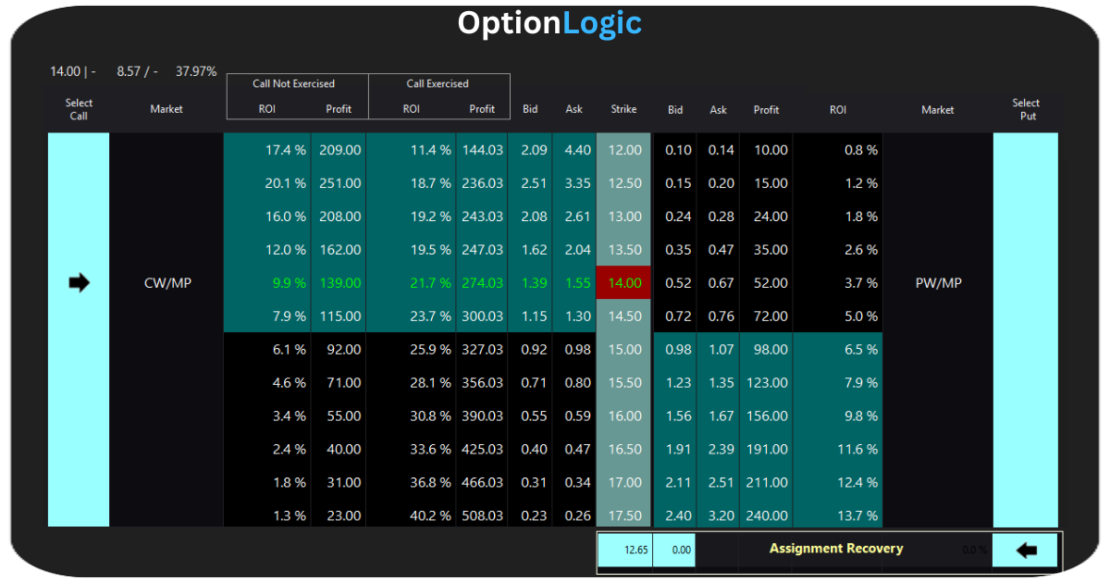
Why the Highest Premium Isn't Always the Best Trade
Introduction
One of the biggest mistakes new options traders make is assuming that the option paying the highest premium is automatically the best opportunity. At first glance, the logic seems reasonable. If one contract pays $180 and another pays $95, the $180 premium appears to be the better trade. Unfortunately, option trading isn't that simple.
Premium tells you how much money you receive for selling an option. It does not tell you how efficiently your capital is being used, how much risk you're taking, or whether another opportunity could produce a better return with less capital.
Professional traders don't compare premium alone.
They compare return. Imagine two cash-secured put opportunities:
- Trade A pays a premium of $180.
- Trade B pays a premium of $95.
Without additional information, most traders would choose Trade A.
But what if Trade A requires $18,000 of capital while Trade B requires only $5,000?
Suddenly, the comparison changes completely.
The smaller premium may actually produce the higher return on the money being committed.
This is why experienced options traders evaluate opportunities using Return on Investment (ROI) rather than premium alone.
ROI answers a much more important question: "How much is my capital earning?" That single question often leads to very different trading decisions than simply chasing the largest premium.
At OptionLogic, ROI is a core part of the analysis process because it allows traders to compare opportunities on equal footing. Instead of focusing on the biggest dollar amount, you can evaluate which trade is making the most efficient use of your available capital.
Premium tells you what you'll receive. ROI tells you how hard your money is working.
What ROI Actually Measures
Return on Investment (ROI) measures how efficiently your capital generates income. Unlike premium, which simply tells you how much money you'll collect from selling an option, ROI considers both the premium received and the amount of capital required to earn it. This makes ROI one of the most useful ways to compare different option opportunities.
For example, imagine two cash-secured put trades:

At first glance, Trade A appears more attractive because it pays nearly twice the premium.
However, after comparing the amount of capital required for each trade, a different picture emerges.
Although Trade B pays a smaller premium, it produces almost twice the return on the capital invested.
This is why experienced traders often evaluate opportunities based on ROI instead of premium alone.
ROI creates a level playing field because it allows every opportunity to be compared using the same measurement, regardless of stock price, strike price, or premium amount.
Without ROI, comparing a $5 stock to a $250 stock is difficult because the premiums are naturally very different. With ROI, both opportunities can be evaluated using the same objective standard. This doesn't mean the trade with the highest ROI is always the best choice.
Many other factors still matter, including:
- Assignment risk
- Open Interest
- Market structure
- Days to expiration
- Earnings
- Liquidity
- Your personal trading objectives
ROI simply answers one important question: "How efficiently is this trade using my capital?"
A Real Trading Example
Let's compare two cash-secured put opportunities.
At first glance, one appears to be the obvious choice because it pays the larger premium.
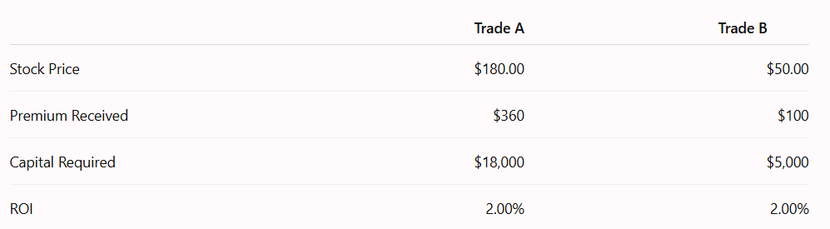
Although Trade A pays more than three times the premium, both trades produce the same return on investment.
If your goal is to earn the highest return on the capital you've committed, these opportunities are essentially equal.
Now let's look at a different comparison.
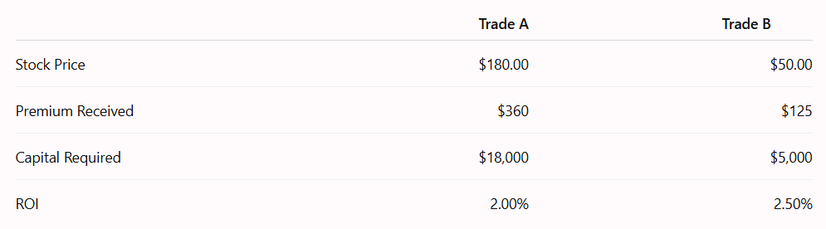
Many traders would still be drawn to Trade A simply because it generates more premium. However, Trade B is actually producing a higher return for every dollar invested. That doesn't automatically make it the better trade.
Trade A may have:
- Stronger support levels
- Lower assignment risk
- Better liquidity
- A higher-quality underlying stock
Likewise, Trade B may carry greater risk despite its higher ROI. The important point is that premium alone cannot tell the whole story. ROI adds essential context by showing how efficiently your capital is working.
Rather than asking: "Which trade pays the most?"
Experienced traders are more likely to ask: "Which trade offers the best balance between return and risk?"
ROI becomes one piece of that decision-making process, helping you compare opportunities objectively while still considering the many other factors that influence an options trade.
How OptionLogic Calculates ROI
Understanding the concept of ROI is important, but calculating it manually for every option in an option chain quickly becomes impractical. A single option chain may contain dozens or even hundreds of available contracts. Calculating the return for each opportunity by hand would be time-consuming and make it difficult to compare trades objectively.
OptionLogic performs these calculations automatically.
For every displayed option, the software calculates the expected Return on Investment (ROI), allowing traders to compare opportunities using a consistent measurement rather than relying solely on premium.
The basic ROI calculation is straightforward:
ROI = Net Premium Received ÷ Capital Required × 100
Where:
- Net Premium Received is the option premium after trading fees.
- Capital Required is the cash needed to secure the position.
By using net premium instead of gross premium, the calculation reflects the actual return received from the trade.
However, ROI is only one part of the analysis. OptionLogic also calculates Annualized ROI, allowing traders to compare opportunities with different expiration dates on a common time basis.
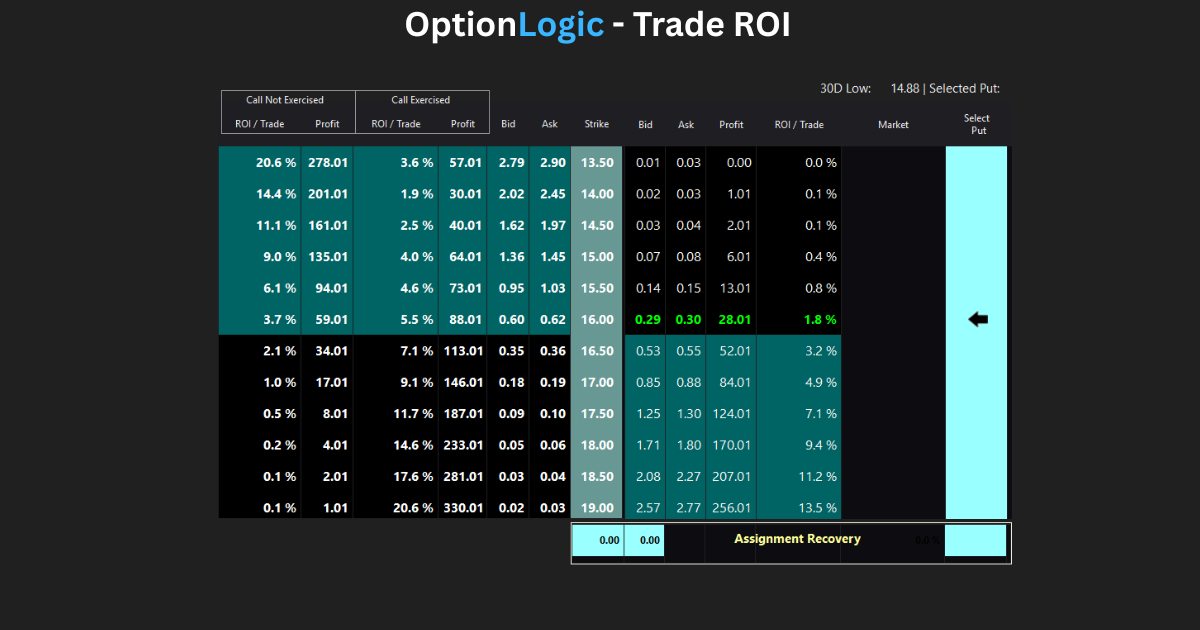
"OptionLogic automatically calculates ROI and Annualized ROI for every displayed option, allowing traders to compare opportunities using consistent objective measurements."
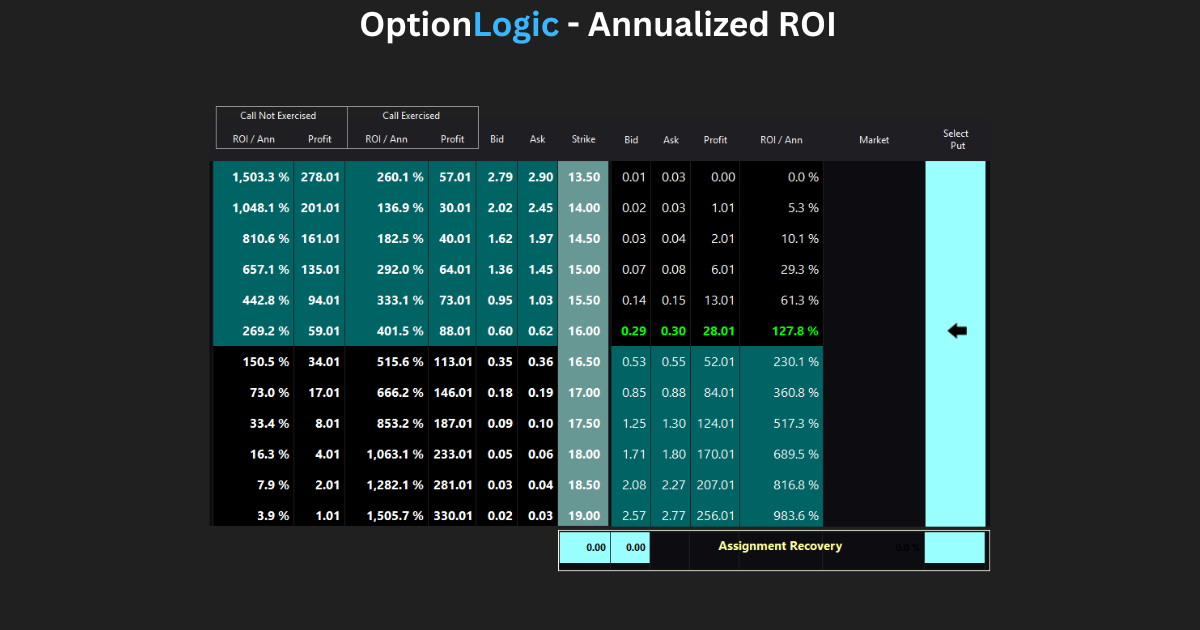
For example, earning a 2% return in one week is very different from earning the same 2% over two months. Annualized ROI helps place those opportunities into perspective without changing the underlying trade. Most importantly, ROI is never presented in isolation. Alongside every opportunity, OptionLogic also displays additional information such as:
- Market Structure
- Put and Call Walls
- Current Position P/L
- Bid/Ask Spread
- Days to Expiration
- Earnings Awareness
- Distance from the Current Stock Price
Together, these measurements provide a more complete picture of each opportunity, allowing traders to compare potential outcomes instead of focusing on premium alone.
Common Mistakes When Comparing Premium
Many option traders naturally focus on premium because it's the most visible number in the option chain.
After all, premium represents the income you'll receive for selling an option.
While premium is certainly important, using it as the primary way to compare opportunities can lead to poor trading decisions.
Here are some of the most common mistakes.
Mistake #1: Choosing the Highest Premium
It's easy to assume that the option paying the largest premium must also be the best trade.
In reality, higher premiums often require significantly more capital or expose the trader to greater risk.
A larger premium does not automatically produce a better return.
Always compare how efficiently your capital is being used—not simply the number of dollars received.
Mistake #2: Ignoring Capital Requirements
Selling a put on a $20 stock requires much less capital than selling a put on a $250 stock.
Comparing premium without considering the amount of capital committed creates an unfair comparison.
ROI solves this problem by measuring the return relative to the capital required for the trade.
Mistake #3: Looking Only at Annualized ROI
Annualized ROI is an excellent comparison tool, but it should never become the only factor driving a trading decision.
A weekly trade may display an attractive annualized return, yet also carry:
- Increased assignment risk
- Wider bid/ask spreads
- Lower liquidity
- An upcoming earnings announcement
Annualized ROI provides valuable perspective, but it should always be evaluated alongside the overall quality of the opportunity.
Mistake #4: Ignoring Market Structure
Two trades may have identical ROI values while offering very different probabilities of success.
For example, one strike may sit below a significant Put Wall while another sits well above it.
Although both trades generate the same return, their market context is different.
This is one reason OptionLogic displays market structure alongside ROI, allowing traders to evaluate opportunities using multiple objective measurements rather than a single number.
Mistake #5: Believing One Number Tells the Whole Story
No single measurement can determine whether an option represents a good opportunity.
ROI...
Premium...
Open Interest...
Liquidity...
Days to Expiration...
Market Structure...
Each contributes one piece of the overall picture.
Experienced traders combine multiple objective measurements before making a decision.
The goal isn't to find one perfect number. The goal is to develop a better understanding of the opportunity.
Good trading decisions are rarely based on a single statistic. They come from understanding how multiple pieces of information work together.
How OptionLogic Helps
OptionLogic transforms raw option chain data into meaningful trading information using objective calculations.
Rather than displaying hundreds of individual option values in isolation, OptionLogic organizes and calculates information that allows opportunities to be compared from multiple perspectives.
These include:
- Return on Investment (ROI)
- Annualized ROI
- Current Position P/L
- Market Structure
- Put and Call Walls
- Bid/Ask Spread Analysis
- Distance from Current Price
- Earnings Awareness
- Position Management
Every feature and calculation is designed to provide additional context.
Frequently Asked Questions
What is the difference between premium and ROI?
Premium is the amount of money received for selling an option. ROI measures that premium relative to the capital required, making it easier to compare different trading opportunities.
Why isn't the highest premium always the best trade?
Higher premiums often require significantly more capital or involve greater risk. A smaller premium with a higher ROI may produce a better return on the capital invested.
Why do experienced traders compare ROI?
ROI provides a consistent way to evaluate opportunities across different stocks, strike prices, and expiration dates. It focuses on how efficiently capital is being used rather than simply how much premium is collected.
Should ROI be the only factor when choosing a trade?
No. ROI should be considered alongside other factors such as stock quality, assignment risk, earnings, liquidity, market structure, and your overall trading objectives.
How does Annualized ROI differ from ROI?
ROI measures the return for a specific trade. Annualized ROI adjusts that return to a one-year period, making it easier to compare opportunities with different expiration dates.
How does OptionLogic use ROI?
OptionLogic automatically calculates ROI for every qualifying option contract, allowing traders to compare opportunities using objective calculations instead of focusing solely on premium. ROI is presented alongside Annualized ROI, market structure, and other measurements to support informed decision-making.
Continue Learning