

Academy > Practical Trading
Market Structure
Academy->Market Structure
Every option chain tells a story.
While many traders focus on premium or strike prices, experienced traders often look for clues about how the options market is positioned. This broader view is known as market structure. Market structure looks beyond individual option contracts to identify areas where buying and selling activity may influence future price movement. Although it cannot predict what a stock will do next, it can provide valuable context when evaluating trading opportunities.
What Makes Up Market Structure?
Several factors can contribute to market structure, including:
- Open Interest
- Put Walls
- Call Walls
- Max Pain
- Support and Resistance
- Option positioning
Each provides a different perspective on how traders are currently positioned.
Looking at them together often produces a clearer picture than relying on a single indicator.
Why Does Market Structure Matter?
Market structure can help traders understand where significant option activity exists.
For example:
- Large Put Open Interest may indicate an area where traders have concentrated bullish positions.
- Large Call Open Interest may indicate an area where traders expect resistance.
- Max Pain can show the price where option pay-outs would be lowest at expiration.
None of these guarantee future price movement. Instead, they provide additional information that traders may use alongside technical analysis, fundamentals, and risk management.
An Example
Suppose a stock is trading at $18.20.
The option chain shows:
- A Put Wall at $18.00
- A Call Wall at $20.00
Some traders may view this as an area where the stock could trade between those two levels until new information changes market expectations.
Whether that actually happens depends on many factors, including news, earnings, overall market conditions, and investor sentiment.
Market Structure Is Context—Not Prediction
One of the biggest misconceptions is believing market structure predicts where a stock will move.
It doesn't.
Market structure simply provides additional context.
Successful traders often combine market structure with other information before making a trading decision.
OptionLogic in Practice
Market Structure is one of the core decision-support features in OptionLogic. Rather than requiring traders to manually analyze thousands of option contracts, OptionLogic identifies important areas such as Put Walls and Call Walls and presents them alongside ROI, slippage, and other position metrics.
The goal isn't to predict the market. It's to help traders better understand the environment in which they are making their decisions.
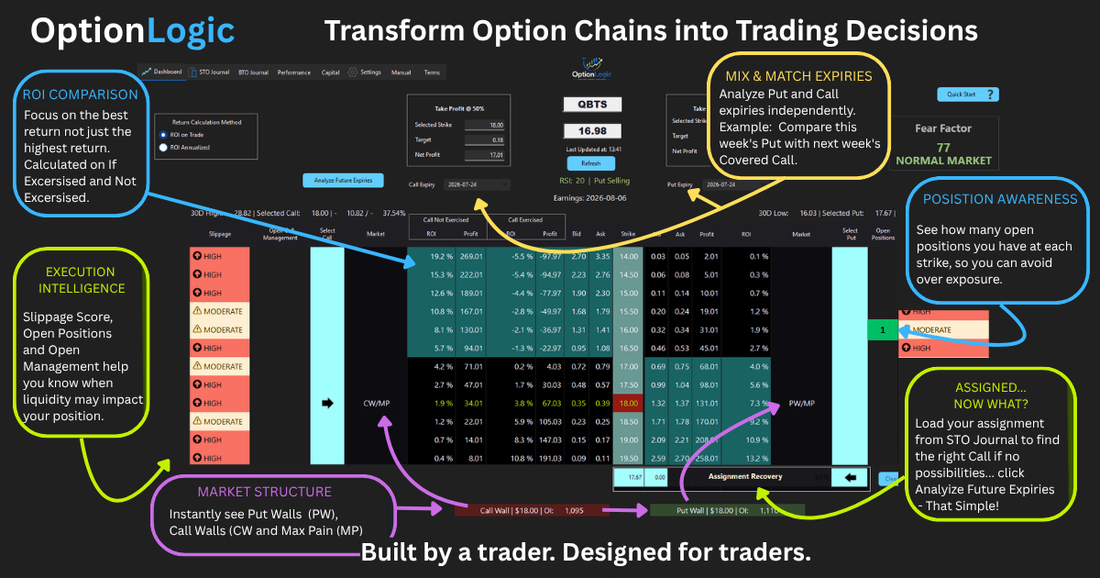
Market Structure - indicated with purple.
Frequently Asked Questions
What is market structure?
Market structure refers to the overall positioning of the options market, including factors such as open interest, Put Walls, Call Walls, and Max Pain.
Can market structure predict stock prices?
No. Market structure provides additional context but cannot predict future price movements.
Why do traders use market structure?
Many traders use it to better understand areas of potential support, resistance, and significant option activity before opening a position.
Is market structure more important than technical analysis?
Neither is universally more important. Many traders combine market structure with technical analysis, fundamentals, and risk management when making trading decisions.
How does OptionLogic help?
OptionLogic automatically analyzes market structure and highlights important option positioning, allowing traders to evaluate the market without manually reviewing large option chains.
Continue Learning