

Academy > Practical Trading
Risk vs Reward
Every options trade involves a balance between risk and reward. Generally speaking, the greater the potential reward, the greater the potential risk. Likewise, reducing risk often means accepting a lower potential return. Successful traders don't try to eliminate risk. Instead, they decide whether the potential reward justifies the amount of risk they are taking.
Understanding the Trade-Off.
Every option contract offers different opportunities.
For example:
- A higher premium may increase your potential income.
- A lower strike price may reduce assignment risk.
- A longer expiration may generate more premium but tie up your capital for a longer period.
There is rarely a "best" choice. Every decision involves a trade-off.
An Example
Suppose you are considering two cash-secured puts on the same stock.
Option A
- Higher premium
- Higher ROI
- Strike price closer to the current stock price
- Greater chance of assignment
Option B
- Lower premium
- Lower ROI
- Strike price farther from the current stock price
- Lower chance of assignment
Neither option is automatically better. The right choice depends on your objectives, your comfort with risk, and how you view the current market.
Avoid Focusing on One Number.
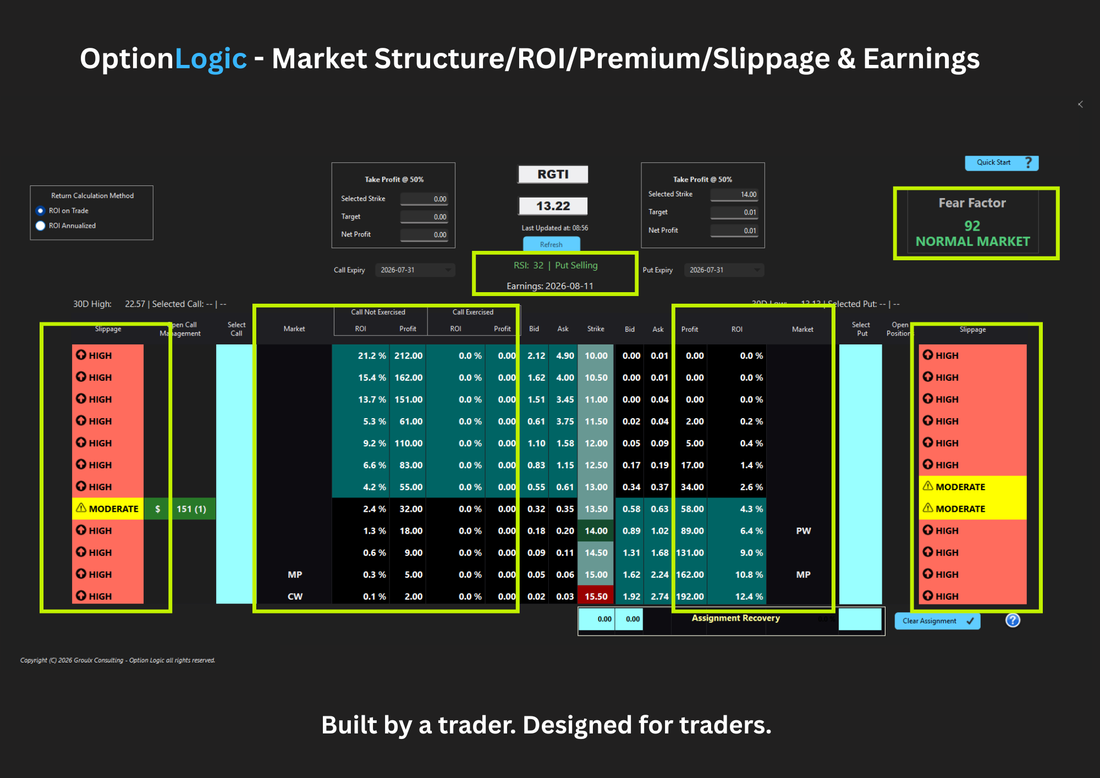
Many new traders compare options using only premium. Experienced traders often evaluate several factors together, including:
- Return on Investment (ROI)
- Annualized ROI
- Strike price
- Days until expiration
- Market structure
- Slippage
- Earnings
- Current position or cost basis
Looking at multiple factors usually provides a better understanding of the overall trade than relying on a single metric.
Risk Is Part of Trading
No strategy removes risk completely.
Even well-planned trades can produce unexpected outcomes because markets constantly change. The goal is not to predict the future. The goal is to make the best decision possible using the information available at the time.
OptionLogic in Practice
OptionLogic is designed to help traders evaluate both risk and potential reward before entering a position. By organizing information such as ROI, annualized ROI, market structure, slippage, earnings, and position metrics, OptionLogic allows traders to compare possible outcomes rather than relying on a single number.
Frequently Asked Questions
What does risk versus reward mean?
Risk versus reward is the balance between the potential return of a trade and the amount of risk required to achieve that return.
Does a higher premium always mean a better trade?
No. Higher premiums often come with greater risk, including a higher chance of assignment or larger price movements.
Can risk be eliminated?
No. Every investment involves risk. The objective is to understand and manage that risk rather than eliminate it.
How do experienced traders evaluate risk?
Many traders consider several factors together, including ROI, strike price, expiration, slippage, earnings, market structure, and their current position.
How does OptionLogic help?
OptionLogic organizes important trading information into one view, allowing traders to compare potential risks and rewards before making a decision.
Continue Learning