

Academy > Practical Trading
Option Decision Analysis
Every options trader eventually faces the same question: "Which option should I choose?" An option chain may contain dozens or even hundreds of contracts with different strike prices, expiration dates, and premiums. Making a good trading decision isn't about finding a single "perfect" option. It's about evaluating the available information and selecting the contract that best fits your objectives and risk tolerance.
Looking Beyond Premium
Many new traders focus on premium alone. While premium is important, it is only one piece of the puzzle. Experienced traders often consider several factors before opening a position, including:
- Return on Investment (ROI)
- Annualized ROI
- Strike price
- Time until expiration
- Bid-ask spread (slippage)
- Market structure
- Assignment risk
- Earnings dates
- Current position or cost basis
Looking at these factors together provides a much clearer understanding of the possible outcomes.
Every Trade Has Trade-Offs
There is rarely a "best" option contract.
For example:
- A higher premium may come with greater assignment risk.
- A lower strike price may reduce risk but generate less income.
- A longer expiration may collect more premium but tie up capital for a longer period.
Every trading decision involves balancing risk and reward.
An Example
Suppose two cash-secured puts are available:
Option A
- Higher premium
- Higher ROI
- Higher assignment risk
Option B
- Lower premium
- Lower ROI
- Lower assignment risk
Neither option is automatically better.
The better choice depends on your objectives, market outlook, and comfort with risk.
There Is No Perfect Answer
One of the biggest misconceptions in options trading is believing there is always one correct decision.
Markets constantly change.
New information becomes available every day.
Successful traders focus on making the best judgment possible using the information available at the time rather than searching for certainty.
OptionLogic in Practice
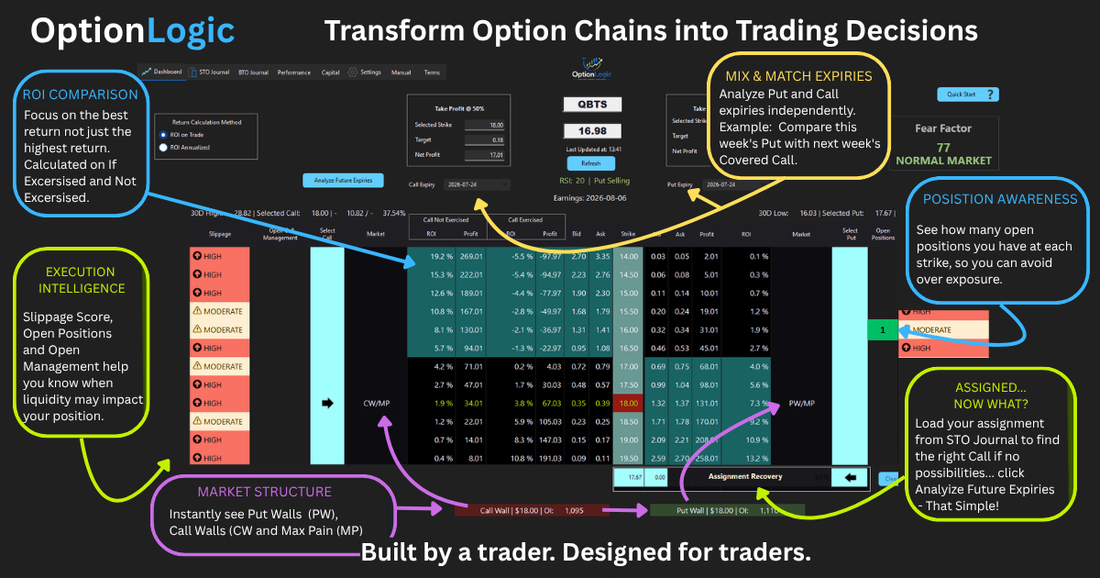
This philosophy is the foundation of OptionLogic. Rather than recommending a specific trade, OptionLogic organizes important information—including ROI, annualized ROI, market structure, slippage, position metrics, and assignment analysis so traders can compare possible outcomes before making a decision.
The goal isn't to predict the future. The goal is to help you make a better-informed trading decision.
Frequently Asked Questions
Is there a perfect option contract?
No. Every option involves trade-offs between potential return, risk, and probability.
What information should I evaluate before opening a trade?
Many traders consider ROI, strike price, expiration, premium, market structure, slippage, earnings, and overall position risk.
Does a higher premium mean a better trade?
Not necessarily. Higher premiums often come with greater risk or a higher chance of assignment.
Does OptionLogic recommend trades?
No. OptionLogic is a decision-support tool that helps organize information so traders can compare possible outcomes and make their own informed decisions.
Why is decision analysis important?
Looking at multiple factors rather than a single number often leads to more balanced and informed trading decisions.
Continue Learning