

Academy > Practical Trading
Why Slippage Matters
Academy->Why Slippage Matters
Many new options traders focus on premium, strike price, and expiration date. However, one factor that is often overlooked is slippage. Slippage is the difference between what you expect to receive for an option and the price at which your order is actually filled. Over time, small amounts of slippage can have a significant impact on your overall trading performance.
What Causes Slippage?
Options are bought and sold using a bid price and an ask price.
- Bid – The highest price a buyer is willing to pay.
- Ask – The lowest price a seller is willing to accept.
The difference between these prices is called the bid-ask spread.
A wider spread generally means greater slippage, while a narrow spread usually allows trades to be filled closer to the expected price.
An Example
Suppose an option has:
- Bid: $1.20
- Ask: $1.40
The spread is $0.20.
If you immediately sell at the bid, you receive $120.
If you immediately buy at the ask, you pay $140.
Although the option appears to be worth around $130, entering and exiting positions can immediately cost approximately $20 per contract because of the spread. Multiply that across many trades, and slippage can noticeably reduce your returns.
Why Does It Matter?
Many traders compare opportunities using premium alone. However, two options with similar premiums may produce different results if one has significantly higher slippage.
Lower slippage often means:
- Better trade execution.
- Lower transaction costs.
- Easier entry and exit.
- More consistent results over time.
OptionLogic in Practice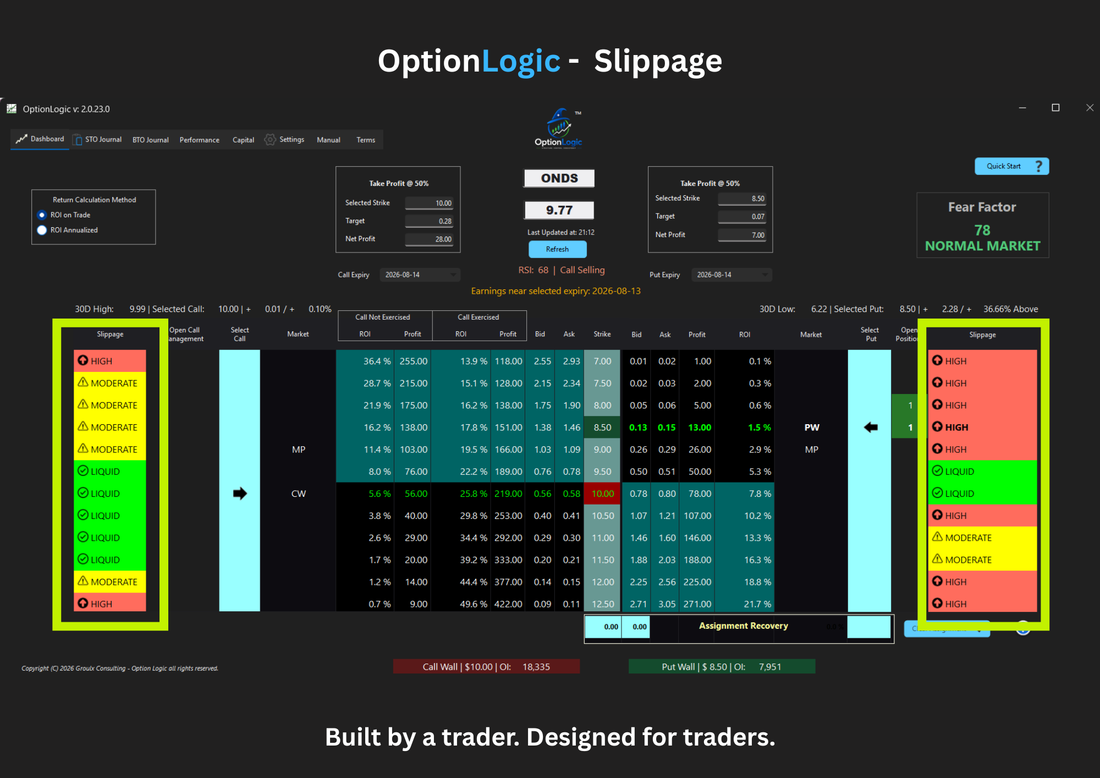
OptionLogic automatically evaluates bid and ask prices and assigns a simple Slippage Score to each option.
Instead of requiring traders to manually compare bid-ask spreads, OptionLogic highlights contracts with Low, Moderate, or High slippage.
This allows traders to quickly identify options that may be easier—or more expensive—to trade.
With OptionLogic Slippage is automatically calculated on each strike.
Frequently Asked Questions
What is slippage?
Slippage is the difference between the price you expect to receive or pay and the actual price at which your option trade is executed.
Is slippage the same as the bid-ask spread?
Not exactly. The bid-ask spread is the difference between the bid and ask prices. Slippage is the practical cost traders experience when entering or exiting a trade because of that spread.
Why is lower slippage better?
Lower slippage generally results in better trade execution and reduces the hidden costs of buying and selling options.
Can slippage affect profits?
Yes. Even small differences in trade execution can reduce returns over time, especially for traders who make frequent option trades.
How does OptionLogic help?
OptionLogic automatically analyzes bid and ask prices and displays a simple Slippage Score, helping traders quickly compare liquidity without manually calculating spreads.
Continue Learning