

Academy > Performance
Portfolio Return
Academy->Portfolio Return
What Is Portfolio Return?
Portfolio Return measures the overall performance of your trading account by comparing your total realized profits and losses to the capital available during the selected time period. Rather than focusing on individual trades, Portfolio Return provides a broader view of how effectively your trading capital has performed over time.
Introduction
Every options trade contributes to your overall portfolio performance. Some trades produce small gains. Some produce losses. Some capital remains invested for weeks, while other positions are opened and closed within days.
Looking at individual trades can provide valuable insight, but it doesn't answer the most important question: "How is my portfolio performing as a whole?" Portfolio Return measures the overall growth of your trading account by considering the combined results of all completed trading activity over a selected period.
Rather than focusing on individual trades, Portfolio Return evaluates the bigger picture. It answers the question every trader eventually asks: "Is my account moving in the right direction?" Unlike ROI, which compares one opportunity, or Capital Efficiency, which examines how capital is being deployed, Portfolio Return measures the overall outcome of your trading decisions.
It becomes the final measurement that ties individual trades into the performance of the entire account.
Why This Matters
A trader may complete fifty profitable trades during the year. Another trader may complete only twenty.
Which trader performed better? The answer cannot be determined by trade count alone. Likewise, collecting thousands of dollars in option premium does not automatically mean the portfolio performed well.
Trading results must always be viewed in the context of the account as a whole. Portfolio Return provides that perspective.
It combines the results of individual positions into a single measurement that reflects overall account performance during the selected period. This allows traders to move beyond evaluating individual successes and instead assess whether their overall trading approach is achieving its intended objectives.
Like every performance measurement discussed throughout the OptionLogic Academy, Portfolio Return is not intended to judge whether a strategy is "good" or "bad." It simply provides another objective measurement that helps traders evaluate their results over time.
Why the Highest Premium Isn't Always the Best Trade
One of the biggest mistakes new options traders make is assuming that the option paying the highest premium is automatically the best opportunity. At first glance, the logic seems reasonable. If one contract pays $180 and another pays $95, the $180 premium appears to be the better trade. Unfortunately, option trading isn't that simple.
Premium tells you how much money you receive for selling an option. It does not tell you how efficiently your capital is being used, how much risk you're taking, or whether another opportunity could produce a better return with less capital.
Professional traders don't compare premium alone.
- Trade A pays a premium of $180.
- Trade B pays a premium of $95.
Without additional information, most traders would choose Trade A.
But what if Trade A requires $18,000 of capital while Trade B requires only $5,000?
Suddenly, the comparison changes completely.
The smaller premium may actually produce the higher return on the money being committed.
This is why experienced options traders evaluate opportunities using Return on Investment (ROI) rather than premium alone.
ROI answers a much more important question: "How much is my capital earning?" That single question often leads to very different trading decisions than simply chasing the largest premium.
At OptionLogic, ROI is a core part of the analysis process because it allows traders to compare opportunities on equal footing. Instead of focusing on the biggest dollar amount, you can evaluate which trade is making the most efficient use of your available capital.
Premium tells you what you'll receive. ROI tells you how hard your money is working.
Why Portfolio Return Is More Than Total Premium
One of the most common misconceptions in options trading is that collecting more premium automatically means generating better overall returns. While premium represents income received from selling options, it tells only part of the story.
Every trading account is affected by many additional factors, including:
- Realized profits and losses
- Assignment outcomes
- Covered call income
- Trading fees
- Capital committed
- Deposits and withdrawals
- The timing of each trade
Looking only at premium ignores how these factors interact over time. For example, a trader may collect substantial premium throughout the year while also experiencing large assignment losses or repeatedly committing capital to low-return opportunities. Another trader may collect less premium but consistently deploy capital more efficiently, resulting in stronger overall portfolio growth.
Neither trader can accurately evaluate performance by looking at premium alone. Portfolio Return brings these pieces together into a broader measurement of account performance. Rather than asking: "How much premium did I collect?"
Portfolio Return asks: "What was the overall result of my trading activity?" That distinction is important.
Successful trading isn't measured by the amount of premium received. It is measured by how the portfolio performs after every gain, every loss, every fee, and every completed position have been considered. Portfolio Return provides that broader perspective.
The Evolution of Performance
As traders gain experience, the questions they ask often change. Many new traders begin by asking: "How much premium can I collect?" With experience, the question often becomes: "How efficiently is my capital working?" Eventually, the focus shifts again: "How is my portfolio performing overall?" This progression reflects a broader understanding of trading performance.
Individual trades remain important, but long-term success is measured by the consistent growth and management of the portfolio as a whole. Portfolio Return helps place every individual trade into that larger context.
How OptionLogic Calculates Portfolio Return
Measuring portfolio performance involves much more than adding together premiums or counting profitable trades.
Every completed trading event contributes to the overall performance of the account, and each event occurs at a specific point in time. OptionLogic organizes these events into a consistent performance calculation, allowing Portfolio Return to reflect the combined outcome of trading activity over the selected period.
Depending on the strategy and account activity, Portfolio Return may include:
- Cash-Secured Put premium
- Covered Call premium
- Buyback transactions
- Assignment outcomes
- Realized gains and losses
- Trading fees
- Deposits and withdrawals
- Capital committed during the selected period
By evaluating completed trading activity together, Portfolio Return provides a broader view of account performance than any individual trade can offer.
Rather than asking traders to manually combine dozens or even hundreds of transactions, OptionLogic performs these calculations automatically using the information already recorded within the trading journal.
Like every calculation within OptionLogic, Portfolio Return is presented as an objective measurement. It summarizes account performance. It does not explain why performance increased or decreased. That understanding comes from examining the underlying trades, position management decisions, and market conditions that contributed to the overall result.
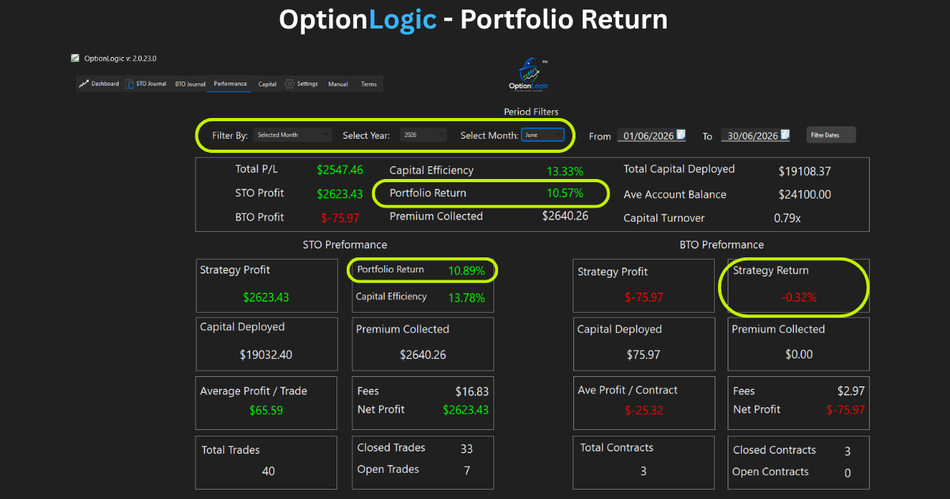
- Portfolio Return summarizes completed trading activity over the selected period, providing an objective measurement of overall account performance.
Common Mistakes When Evaluating Portfolio Performance
Portfolio Return provides valuable insight into overall account performance, but it is often misunderstood.
Here are several common mistakes.
Mistake #1: Measuring Success by Premium Alone
Premium represents income. It does not represent profitability.
Trading fees, assignment outcomes, buybacks, and realized gains or losses all contribute to the final portfolio result.
Portfolio Return considers these factors together.
Mistake #2: Focusing on Individual Trades
Every trader experiences winning and losing positions. Evaluating performance based on a single trade can create a misleading impression of long-term results. Portfolio Return helps shift the focus from isolated trades to consistent performance over time.
Mistake #3: Ignoring Time Periods
Performance should always be viewed within a defined time frame. Comparing one month with an entire year rarely provides meaningful insight. Using consistent reporting periods allows performance to be evaluated more objectively.
Mistake #4: Confusing Activity with Progress
Completing more trades does not necessarily produce better results. Some traders generate excellent returns through relatively few high-quality opportunities. Others trade frequently without improving overall portfolio performance.
Portfolio Return measures results—not activity.
Mistake #5: Expecting One Number to Explain Everything
Portfolio Return summarizes overall performance. It does not identify which trades contributed most to the result or explain every factor affecting the account. Understanding those details requires examining the underlying trading activity.
Portfolio Return is the destination. The individual trades explain the journey.
__
Portfolio Return tells you where your portfolio is. Your trading journal explains how it got there.
Key Takeaways
Portfolio Return provides a broader perspective than any individual trade. While ROI measures individual opportunities, Annualized ROI compares opportunities across time, and Capital Efficiency evaluates how effectively capital is deployed, Portfolio Return answers the most important question of all: "How is my trading account performing overall?"
Remember these key principles:
- Portfolio Return measures overall account performance—not individual trades.
- Premium alone does not determine portfolio success.
- Every completed trading event contributes to overall performance.
- Consistent results matter more than individual winning trades.
- Portfolio Return summarizes the outcome. The trading journal explains how that outcome was achieved.
Evaluating performance at the portfolio level allows traders to identify long-term trends that individual trades alone cannot reveal. Successful trading isn't about one exceptional trade. It's about building consistent results over time.
How OptionLogic Helps
OptionLogic automatically organizes completed trading activity into meaningful performance measurements.
Rather than manually calculating results across multiple positions, dates, and transactions, Portfolio Return summarizes overall account performance using the information already recorded within the trading journal. Portfolio Return works alongside other performance measurements including:
- Return on Investment (ROI)
- Annualized ROI
- Capital Efficiency
- Strategy Performance
- Current Position P/L
Each measurement answers a different question. Together they provide a broader understanding of trading performance from the individual trade to the portfolio as a whole.
OptionLogic doesn't determine whether your trading strategy is successful. It organizes the objective information that allows you to evaluate your own performance with confidence. The calculations describe the results. The interpretation remains with the trader.
Frequently Asked Questions
What is Portfolio Return?
Portfolio Return measures the overall percentage return generated by your trading account during a selected period. It evaluates total trading performance rather than the outcome of any single position.
How is Portfolio Return different from ROI?
ROI measures the return of an individual trade. Portfolio Return measures the combined performance of all completed trades relative to the capital available in your account.
Why is Portfolio Return important?
Portfolio Return helps traders evaluate whether their overall trading approach is producing consistent results. It provides a broader perspective than focusing on individual winning or losing trades.
Does Portfolio Return include every trade?
Yes. Portfolio Return is designed to reflect the combined results of completed trades within the selected reporting period, providing a more complete picture of trading performance.
Why should I track Portfolio Return instead of individual trades?
Individual trades only tell part of the story. Portfolio Return helps identify long-term consistency by measuring how your account performs as a whole over time.
How does OptionLogic calculate Portfolio Return?
OptionLogic calculates Portfolio Return using your trading activity together with your account balance, deposits, and withdrawals during the selected reporting period. This provides a realistic measure of overall account performance rather than simply adding together individual trade returns.
Continue Learning