

Academy > Position Management
Choosing Covered Call Expiries
Academy->Choosing Covered Call Expiries
How Do You Choose a Covered Call Expiry?
Choosing a covered call expiration involves balancing premium income, time commitment, flexibility, and the likelihood of assignment. Shorter expirations may generate more frequent trading opportunities, while longer expirations often provide higher premiums but commit your shares for a longer period. The best choice depends on your trading objectives and how you want to manage the position.
Understanding the Trade-Offs
One of the first decisions every covered call trader makes is selecting an expiration date.
Weekly options...
Monthly options...
Longer-dated expirations...
Each offers different characteristics.
A common question among traders is: "Which expiration is best?" The answer depends on the objectives of the individual trader. There is no single expiration that is appropriate for every position or every market condition. Instead of searching for a universally "best" expiration, experienced traders often compare how different expiration dates change the position they already own.
Shorter expirations generally provide more frequent opportunities to manage a position. Longer expirations may generate higher premiums while committing the position for a longer period. Neither approach is inherently better. Each represents a different balance between income, flexibility, and time.
Understanding those trade-offs is one of the foundations of effective covered call management.
Every Expiration Creates Different Opportunities
Changing the expiration date affects far more than the premium collected.
It also changes:
- Days committed to the position.
- Return on Investment (ROI).
- Annualized ROI.
- Time available for stock price movement.
- Frequency of future management decisions.
- Opportunity to adjust the position.
Each expiration creates a different set of possibilities. A one-week covered call and a six-week covered call are not simply separated by time. They create different management paths for the same position.
Understanding those differences helps traders compare opportunities using objective information rather than relying on a single measurement.
A Real Trading Example
Imagine owning 100 shares and evaluating three covered call opportunities.
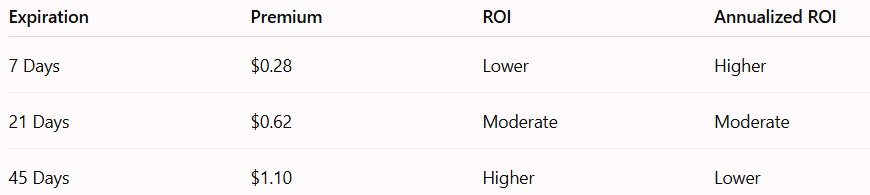
Looking only at premium, the 45-day expiration appears most attractive. However, the picture changes when time is considered. The 7-day expiration commits the position for only one week, allowing another covered call to be evaluated much sooner. The 45-day expiration produces more immediate income but commits the position for a significantly longer period.
Neither opportunity is automatically superior.
They simply represent different approaches to managing the same position. Understanding those trade-offs allows the trader to select the expiration that best fits their objectives.
Time Is Part of Every Decision
Every covered call commits the position for a period of time. During that period, several outcomes remain possible.
The shares may remain below the strike. The shares may be assigned. Market conditions may change. New opportunities may emerge.
Choosing an expiration therefore involves more than collecting premium. It also involves deciding how long the trader is comfortable committing the current position before making another management decision. Some traders prefer making frequent adjustments. Others prefer collecting larger premiums while reducing the number of management decisions throughout the year. Neither approach is universally correct.
The important consideration is understanding how time changes the position.
How OptionLogic Approaches Expiration Selection
OptionLogic presents covered call opportunities across multiple expiration dates using consistent objective calculations.
Rather than emphasizing premium alone, the software allows traders to compare opportunities using measurements including:
- Return on Investment (ROI)
- Annualized ROI
- Current Position P/L
- Assignment Outcomes
- Market Structure
- Bid/Ask Spread Analysis
- Earnings Awareness
- Days to Expiration
Viewing these calculations together provides a broader understanding of how different expiration dates affect the existing position.
Common Misconceptions
One common misconception is that longer expirations are always better because they collect more premium.
Although longer expirations often generate larger premiums, they also commit the position for a longer period and may reduce flexibility.
Another misconception is that weekly covered calls always produce the highest returns. While shorter expirations may produce attractive annualized returns, they also require more frequent management and additional trading decisions.
Some traders also believe expiration should be selected using premium alone. In reality, premium represents only one part of the overall decision. Time, flexibility, assignment outcomes, market conditions, and overall position management all contribute to evaluating different expiration opportunities.
Understanding those relationships provides a much more complete perspective than comparing premium by itself.
Key Takeaways
Choosing an expiration date involves balancing multiple considerations rather than maximizing a single measurement.
Remember these key principles:
- Every expiration changes the position differently.
- Time is part of every covered call decision.
- Premium and time should be evaluated together.
- Different expirations create different management opportunities.
- Objective calculations provide context. The trader determines which trade-offs best support their objectives.
How OptionLogic Helps
OptionLogic allows traders to compare covered call opportunities across multiple expiration dates using consistent objective calculations. Rather than evaluating premium in isolation, the software organizes ROI, Annualized ROI, Current Position P/L, Market Structure, Assignment Outcomes, and other objective measurements into a single view.
This allows traders to understand how changing the expiration date influences the overall position.
Frequently Asked Questions
Why does expiration matter?
The expiration date affects premium, time commitment, flexibility, and how quickly you can adjust or re-evaluate your position. Different expirations create different trade-offs.
Are shorter expirations always better?
Not necessarily. Shorter expirations may allow more frequent premium collection, but they often provide smaller premiums and require more active management.
Are longer expirations always better?
No. Longer expirations generally offer higher premiums, but they also commit your shares for a longer period and reduce your flexibility if market conditions change.
Should I always choose the highest premium?
No. The highest premium may not produce the best overall outcome. Expiration length, annualized ROI, strike selection, assignment potential, and your trading objectives should all be considered.
How do I compare different expiration dates?
Comparing ROI, Annualized ROI, premium, strike price, and position outcomes can provide a more complete picture than evaluating premium alone. Each expiration represents a different balance between income and flexibility.
How does OptionLogic help choose covered call expiries?
OptionLogic compares multiple expiration dates using objective calculations such as ROI, Annualized ROI, Position P/L, and Recovery Analysis. Rather than recommending a specific expiration, the software organizes the information so traders can compare possible outcomes and select the expiration that best fits their objectives.