

Academy > Option Strategies
Managing Assigned Shares
Academy->Managing Assigned Shares
Assignment can feel disappointing when it happens for the first time, but for many options traders, it is simply part of the trading process. Once shares have been assigned, the focus shifts from managing an option contract to managing a stock position. Rather than asking, "How do I avoid assignment?", many experienced traders ask: "What's the best way to manage the shares I now own?"
What Happens After Assignment?
When a cash-secured put is assigned, you purchase the shares at the strike price specified in the option contract. From that point forward, you become a shareholder and have several possible choices.
Many traders decide to:
- Hold the shares.
- Sell covered calls.
- Sell the shares.
- Wait for market conditions to improve.
- Reduce their cost basis by collecting additional option premium.
There is no single correct answer. The best decision depends on your objectives and the current market.
Don't Focus Only on the Stock Price. One of the biggest mistakes new traders make is focusing only on the current share price. Successful position management often involves considering the entire investment, including:
- Original purchase price.
- Premium collected from selling the put.
- Any covered call premium earned.
- Current cost basis.
- Current profit or loss.
Looking at the complete position provides a much clearer understanding than looking at the stock price alone.
An Example
Suppose you sold an $18.00 cash-secured put and were assigned 100 shares.
After assignment:
- You collected $120 selling the put.
- You later collected $85 selling a covered call.
- Your adjusted cost basis has been reduced.
Although the stock may still be trading below your original purchase price, the premium collected has improved the overall position.
This is why many traders focus on managing the position rather than reacting to short-term price movements.
Managing the Position
Once shares have been assigned, traders often evaluate questions such as:
- Should I sell a covered call?
- Has my cost basis changed?
- What is my current position profit or loss?
- What covered call opportunities are available?
- Should I continue holding the shares?
Each decision builds on the current position rather than treating every trade as an isolated event.
OptionLogic in Practice
Managing assigned shares is one of the core ideas behind OptionLogic. The software continuously tracks your cost basis, premiums collected, current position value, and potential covered call opportunities, helping you understand your position before deciding what to do next. Rather than tracking individual transactions, OptionLogic focuses on the complete investment, allowing you to evaluate possible outcomes as your position evolves.
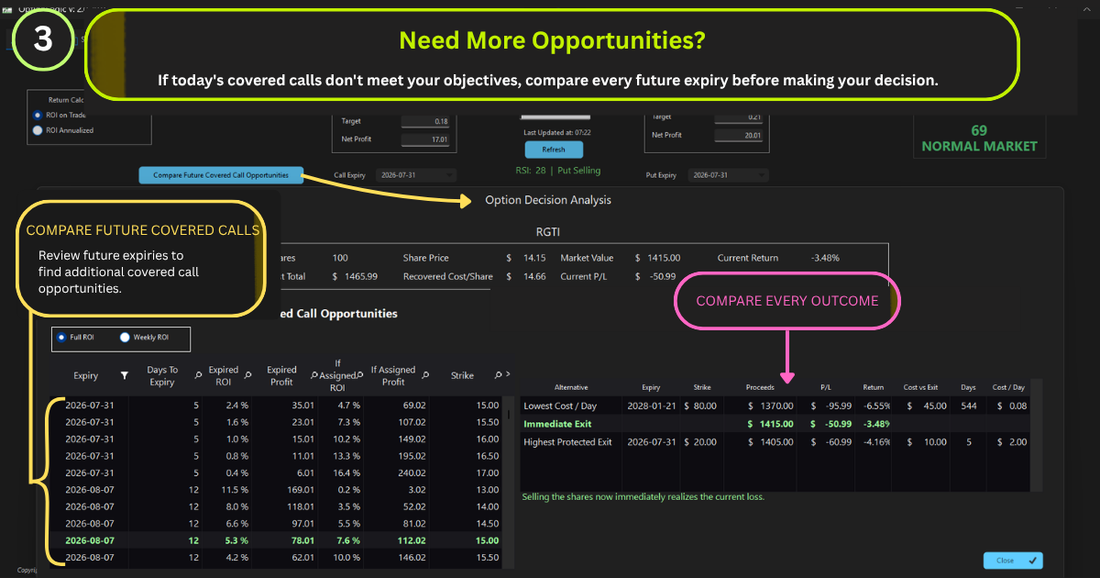
Easy process once assigned - In STO Journal, select the ticker and send to dashboard. Click the blue button on Dashboard as shown and all future calls with positive ROI and Premiums are filtered. This is normally done when there are no opportunities available with near strikes or strikes that are closer to your current date of trading.
Frequently Asked Questions
What happens when a cash-secured put is assigned?
You purchase the shares at the option's strike price and become the owner of the stock.
Is assignment always a bad thing?
No. Many options strategies, including the Wheel Strategy, are designed with assignment as a possible outcome.
What can I do after assignment?
Common choices include holding the shares, selling covered calls, selling the stock, or continuing to manage the position based on your objectives.
Why is cost basis important after assignment?
Premium collected from selling options can reduce your effective purchase price, providing a more complete picture of your investment than the stock price alone.
How does OptionLogic help?
OptionLogic tracks your complete position—including cost basis, premiums collected, current position performance, and covered call opportunities—helping you make informed decisions after assignment.
Continue Learning