

Academy > Option Basics
What Is In the Money (ITM), At the Money (ATM), and Out of the Money (OTM)?
Academy->What is In The Money, At The Money and Out of The Money
Every option contract falls into one of three categories:
- In the Money (ITM)
- At the Money (ATM)
- Out of the Money (OTM)
These terms simply describe the relationship between the stock price and the strike price. Once you understand those two prices, these definitions become easy.
Once you understand those two prices, these definitions become easy.
In the Money (ITM)
An option is In the Money (ITM) when it already has value if exercised.
Call Option
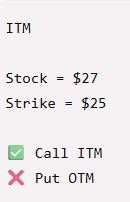
A call option is In the Money when the stock price is above the strike price.
Example
- Stock Price: $27
- Strike Price: $25
The call is $2 In the Money.
Put Option
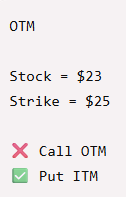
A put option is In the Money when the stock price is below the strike price.
Example
- Stock Price: $23
- Strike Price: $25
The put is $2 In the Money.
___
At the Money (ATM)
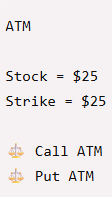
An option is At the Money (ATM) when the stock price is very close to the strike price.
Example
- Stock Price: $25
- Strike Price: $25
Neither the call nor the put has intrinsic value at this point.
___
Out of the Money (OTM)
An option is Out of the Money (OTM) when exercising it would not make sense.
Call Option
A call option is Out of the Money when the stock price is below the strike price.
Example
- Stock Price: $23
- Strike Price: $25
Put Option
A put option is Out of the Money when the stock price is above the strike price.
Example
- Stock Price: $27
- Strike Price: $25
___
Whether an option is ITM, ATM, or OTM affects:
- Its premium.
- Its intrinsic value.
- The probability of assignment.
- How traders evaluate different opportunities.
Understanding these terms makes it much easier to compare option contracts.
OptionLogic in Practice
OptionLogic displays live option chain data, allowing you to compare different strike prices, premiums, ROI, market structure, and other information before selecting an option. Understanding whether an option is ITM, ATM, or OTM provides additional context when evaluating potential trades.
Frequently Asked Questions
Can an option move from OTM to ITM?
Yes. As the stock price changes, an option can move between Out of the Money, At the Money, and In the Money.
Is an ITM option always better?
No. Different traders choose ITM, ATM, or OTM options depending on their strategy and objectives.
Can a call and a put both be At the Money?
Yes. When the stock price is very close to the strike price, both the call and put at that strike are considered At the Money.
Why do ITM options usually cost more?
Because they already contain intrinsic value, they generally trade for a higher premium than comparable ATM or OTM options.
Do ITM options have a greater chance of assignment?
Generally, yes. Because they already have intrinsic value, ITM options are more likely to be exercised than OTM options, although assignment depends on several factors.
Continue Learning