

Academy > Option Basics
What Is Early Assignment?
Academy->What Is Early Assignment
Most options remain open until they expire. Sometimes, however, the buyer of an option chooses to exercise it before the expiration date. When that happens, the seller is assigned early. Although early assignment is possible, it is much less common than assignment at expiration.
Why Does Early Assignment Happen?
The buyer of an option decides whether to exercise it.
There are several reasons why they might choose to do so before expiration, including:
- The option is deep In the Money.
- A dividend is approaching.
- They want to own or sell the shares immediately.
Early assignment depends on the buyer's decision, not the seller's.
What Happens If You're Assigned Early?
The outcome is the same as regular assignment.
The only difference is when it happens.
Cash-Secured Put
If you're assigned early on a cash-secured put:
- You purchase the shares at the strike price.
- You keep the premium you received.
Covered Call
If you're assigned early on a covered call:
- Your shares are sold at the strike price.
- You keep the premium you received.
Can Early Assignment Be Predicted?
No. No one knows exactly when another trader may choose to exercise an option. Some situations make early assignment more likely, but it can never be guaranteed. That's why traders should always understand the possible outcomes before selling an option.
A Real-World Example
Suppose you own 100 shares with a net cost of $12.00 per share.
The stock is currently trading at $12.00, and you decide to sell a covered call.
- Strike Price: $18.00
- Expiration: 6 months
- Premium Received: $1.28 per share ($128)
Two months later, unexpected news sends the stock to $25.00.
The buyer exercises the option early.
What happens?
- Your 100 shares are sold for $18.00 per share.
- You keep the $128 premium you received when you sold the call.
- The position closes four months earlier than expected.
Although the stock is now worth $25.00, your agreement was always to sell the shares for $18.00 if the option was exercised.
Early assignment didn't change the agreement. It simply completed it sooner.
Why This Matters
Many traders focus on the fact that the stock reached $25.00.
Experienced traders often look at something different.
Before selling the covered call, they had already decided they were willing to sell their shares at $18.00 in exchange for receiving the option premium.
The important question isn't: "Why was I assigned?"
It's: "Did this trade achieve the outcome I planned?"
OptionLogic in Practice
This is where OptionLogic takes a different approach.
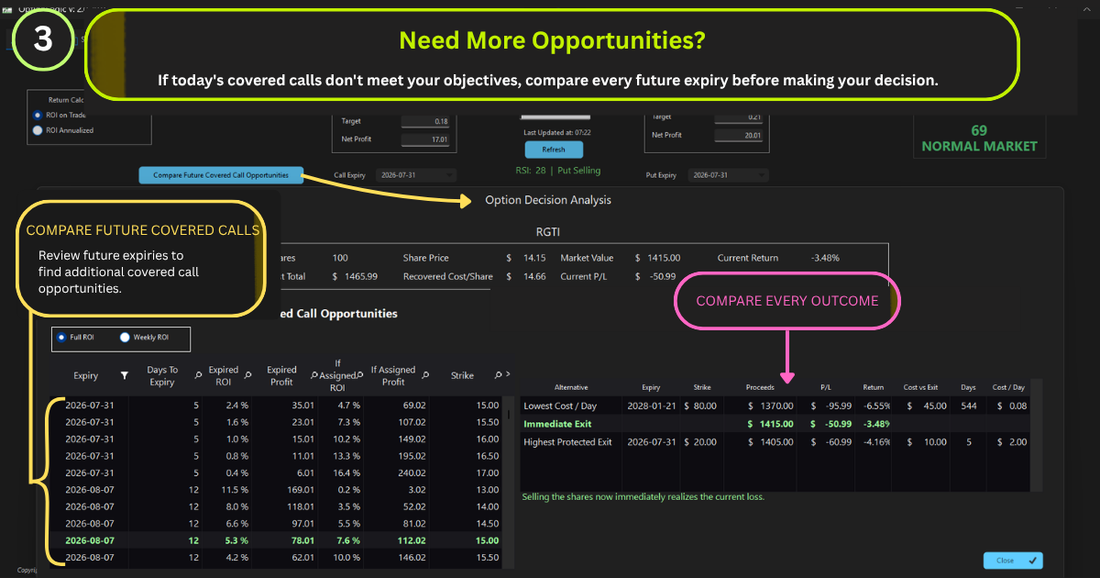
Instead of simply recording that an assignment occurred, OptionLogic evaluates the entire position.
It considers:
- Your net cost per share.
- Every premium collected.
- Any buybacks or adjustments.
- Fees.
- The final sale price of the shares.
The result is a complete picture of how the position actually performed—not just whether you were assigned.
Frequently Asked Questions
Is early assignment common?
No.
Most options are either closed before expiration or remain open until expiration.
Early assignment is possible but generally less common.
Can I prevent early assignment?
No.
The buyer decides whether to exercise the option.
As the seller, you cannot control that decision.
Do I lose the premium if I'm assigned early?
No.
You keep the premium you received when you sold the option.
Is early assignment different from regular assignment?
The outcome is the same.
The only difference is that it happens before the option's expiration date.
Does early assignment mean something went wrong?
No.
It simply means the buyer chose to exercise the option before expiration.
Continue Learning